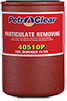

Fuel Dispenser Filter FAQ
The fuel industry is a highly technical industry that is constantly adapting to meet changing consumer demands and increasingly strict compliance regulations. As a longtime manufacturer of dispenser filters, PetroClear is glad to share its expertise to simplify some of the more complex aspects of fuel dispenser filtration. Read the answers to these Frequently Asked Questions to learn more.
Filters can trap dirt and water, plus they can cause a "slow-flow" condition that alerts the tank owner of phase separation. They trap dirt by intercepting the particle in the filter media. A filter traps water by using a chemical that allows the gasoline to pass through while reacting with nd absorbing the water. For the alcohol-water "cocktail" liquid mix known as phase separation, a special chemical reacts with the liquid and slows the flow through the filter.
The filter is a sign that there are changes either in your fuel or in the tank. You should test the fuel that's in the filter when you remove it. Or you can call a fuel system service company and have them analyze the fuel.
Generally speaking, a well maintained system will allow the owner to change the filter every six months or 500,000 gallons.
If a filter has a high efficiency rating, it will trap more contaminates. Therefore it has to have a high capacity to hold all of those contaminates. Based on the location of most filters, the size (capacity) of the filter is limited.
The word micron is another term for micrometer (1 millionth of a meter). A micrometer is a unit of linear measure in the metric system used to measure distance from one point to another. The lower limit of visibility or the naked eye is 40 microns.
The diameter of average human hair is 40-70 microns, a red blood cell is 8 microns and bacteria is 2 microns.
A micron rating for a fluid filter is a generalized way of indicating the ability of the filter's media to remove contaminants by the size of particles it is exposed to. The two most popular reported media ratings are a nominal micron rating (50%) and an absolute micron rating (98.7%). A nominal rating usually means the filter's media can capture a given percentage of particles of a stated size. For example, a filter might be said to have a nominal rating of 50% for particles 10 micrometers in size or larger. An absolute micron rating can be determined by single-pass or multi-pass testing and is usually obtained by passing a test fluid containing particles of a known size through a small, flat sheet of filter media. Any particles that pass through the media are captured and measured. An absolute rating is also expressed in the form of a percentage of the size of particles captured.
There are three basic parts: cannister (the container), the element (filter media) and the core (center tube).
Because of today's fuel standards and options there is quite a bit of research being done. Bio-fuels, such as bio-diesel and ethanol-blended gasoline are a big challenge to fuel retailers who turned to the people at Petro Clear to help them keep their fuel clean in order to keep customers satisfied.
Petro Clear has distributors around the world. The distributors are generally called "Petroleum Equipment Distributors". The may also service petroleum equipment, and/or they sell to companies who do service work on petroleum equipment, and people who own petroleum tanks and systems.